Drive Selection - English Units |
This page describes the steps for selecting chain and sprockets in a power transmission application. If you prefer a more automated selection process, check out
Ramsey’s Drive Selection program. This free program is designed to run with Microsoft Windows and will require about 5.3MB of disk space. Simply input your drive
conditions and the program will guide you, step by step, in the choice of chain and sprocket pitch, width, and part number. Dimensional information, as well as, chain
length and drive center distance is displayed. To download and install the program please click HERE. You will be asked to complete a registration form and follow the
online instructions for installation.
|
Click Here for Metric Units |
Drive Selection - Step by Step
Drive selection consists of choosing the appropriate chain and sprockets for the
space, loads, and speeds involved. Often more than one pitch and width will
work in a given situation. In such cases one may choose two or three possible
selections and base the final choice on factors such as cost, stock availability,
ruggedness or space availability |
Information Needed
- Type of power source and application
- Shaft center distance(CD)
- Shaft diameters and keyway sizes
- Power to be transmitted(W)
- RPM of shafts(N1=faster shaft speed, N2=slower shaft speed)
|
Follow These Steps
1. Choose a service factor(SF) from the Service Factor table.
2. Compute the design horsepower(Wd) by multiplying the power to be
transmitted(W) by the service factor.
|
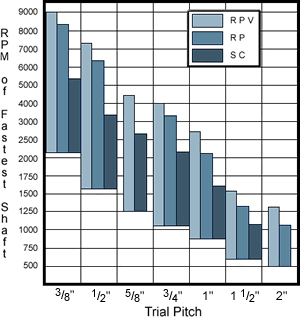
3. Use the speed of the faster
moving shaft(N1) to make a
tentative pitch selection(p) from
the chart .
4. Select the number of teeth in the small sprocket(Z1), making sure the
sprocket can accommodate the shaft diameter. See maximum sprocket bores
in sprocket tables.
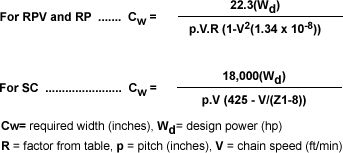
5. Use the following equations to calculate the required chain width(Cw). If the required chain width is not readily available it may be necessary to go to a wider chain or a larger sprocket. |
 |
|
 |
|
|
Table of R Values
|
Pitch |
3/8" |
1/2" |
5/8" |
3/4" |
1" |
1 1/2" |
2" |
RPV (SG) |
1.5 |
1.8 |
na |
1.6 |
1.5 |
1.1 |
1.0 |
RPV (CG) |
1.5 |
1.8 |
na |
1.3 |
1.2 |
1.1 |
1.0 |
RP |
.922 |
1.0 |
1.0 |
1.0 |
1.0 |
1.0 |
1.0 |
|
6. Select the large sprocket (Z2) by multiplying the number of teeth in the small
sprocket by the desired shaft speed ratio.
Z2 = Z1 x N1/N2
7. Compute the chain length (Click Chain Length for instructions). If the
computed length is fractional, round off to the nearest whole number of pitches.
An even number of pitches is always preferable to an odd number of pitches
which requires an offset section. If an offset section is required it will be
necessary to increase the width of the chain by 25% to account for the offsets
reduced tensile strength. Note: offset sections are not available for RPV chain.
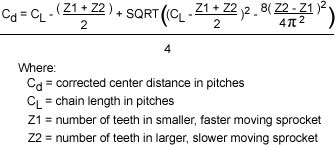
8. Compute the new center distance (Cd) for the rounded off chain length. The
following formula provides an approximate center distance. When fixed center
drives are used or extremely accurate center distance is required consult
Ramsey. |
 |
9. Select a method for lubricating the drive.
Forced feed lubrication will provide optimum results and is recommended
whenever chain speeds exceed 2500 ft/min. Drip or bath type lubrication may be
acceptable at lower speeds. Additional information on lubrication is given in the
section describing lubrication. Also, if the drive will not operate inside a housing,
a chain enclosure is recommended. |
|
|
| |
|
|